


In this article
To remake trending Reels on-brand for teams, keep the skeleton of the trend and replace everything that makes it someone else’s: hook line, footage, on-screen voice, and CTA. Copying the audio and swapping a logo still reads as a clone.
Below you will find five pass or fail checks, first-second examples across beauty, F&B, D2C, services, SaaS, and agencies, one worked example from start to finish, and a checklist you can run before you spend a filming day on a trend.
What do you keep from a trend, and what do you throw out?
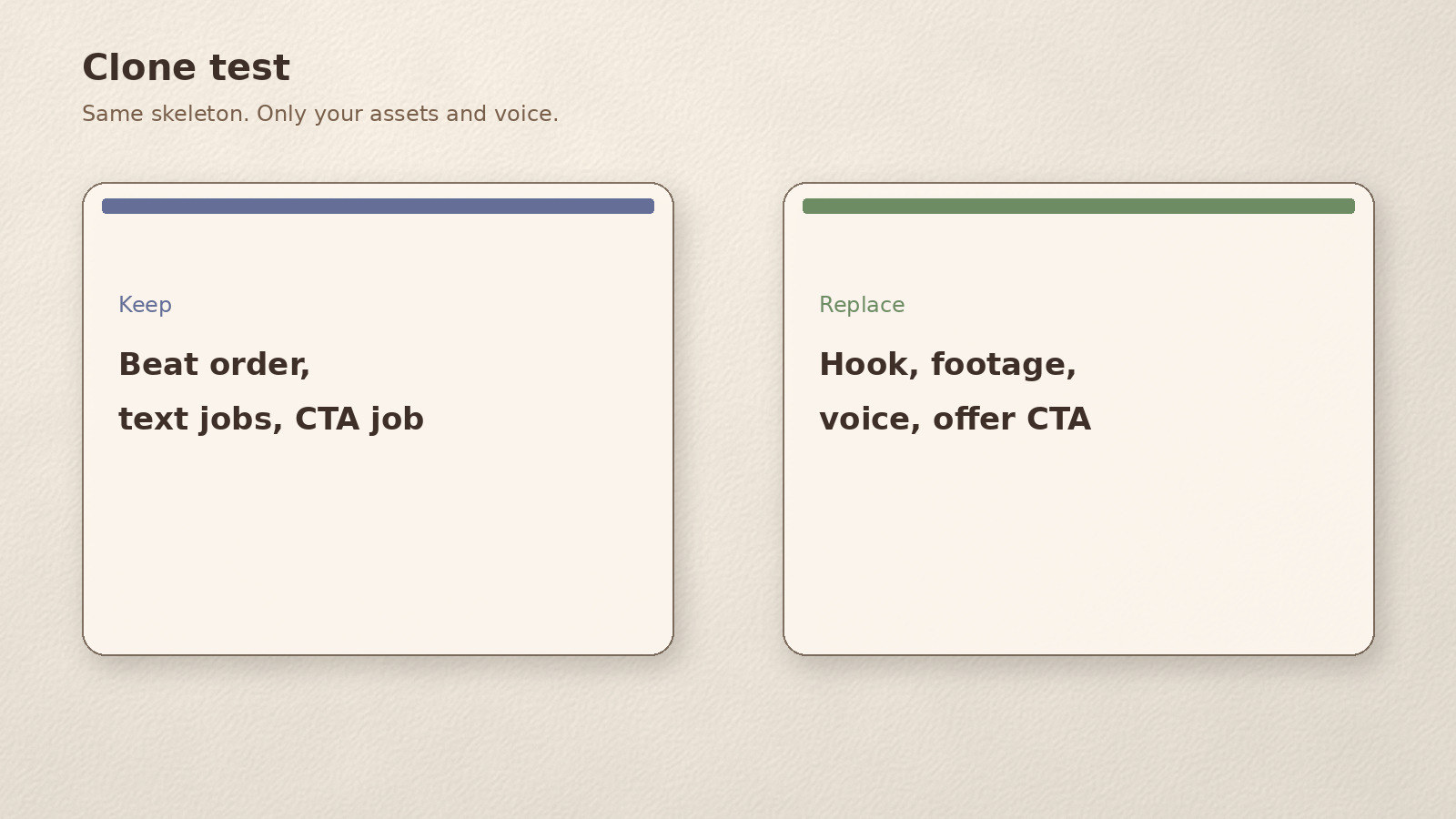
Keep the beat order and the job of each text line. Throw out their joke, their face, their product, and their CTA. If you cannot explain the skeleton in one sticky note (hook, beats, text jobs, CTA), you do not understand the trend well enough to remake it.
This is different from opening a blank CapCut timeline (blank CapCut timeline vs starting from a proven format). It is also different from browsing a template library (Instagram Reels templates for brands). Remap starts from a live trend you already saw, then filters it through Brand DNA from your website.
Five checks before you film
| Check | Pass if | Fail if |
|---|---|---|
| Buyer fit | Your persona would care about the joke or job | It only works for a different audience |
| Offer fit | You can land on your product or service truth | The payoff is unrelated to what you sell |
| Voice fit | The line could appear on your site | You would never say it in Brand DNA tone |
| Asset fit | You can film or assemble it this week | It needs a shoot you cannot finish |
| Rights fit | Sound and format are OK for your account type | Business audio blocked; unclear UGC rights |
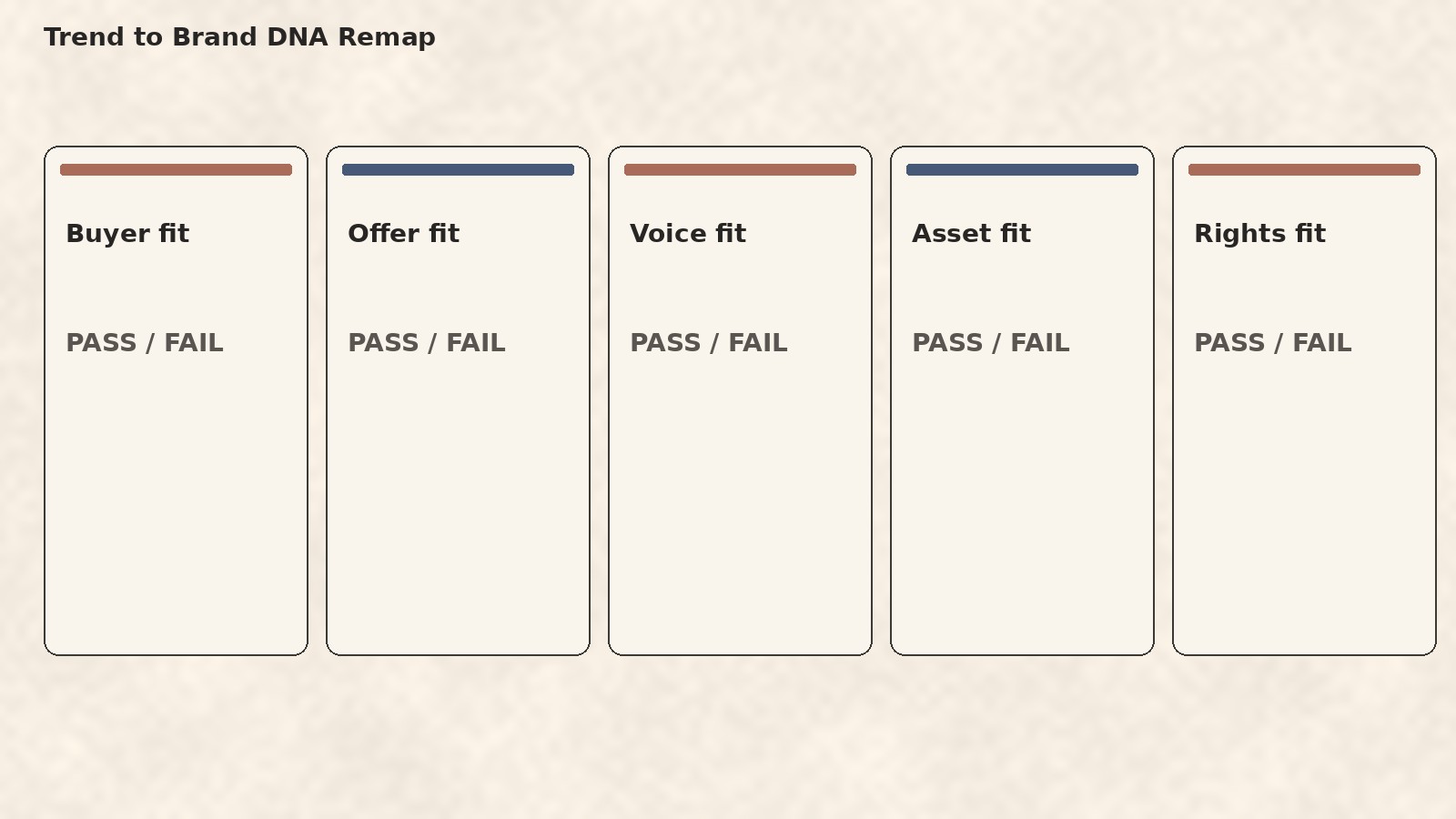
Fail any check and skip the trend. Skipping is strategy. Forced participation fills feeds with clones that earn neither trust nor saves.
What should the first three seconds of a remake show?
Beauty. Open on your product or hands, not a copy of the creator’s bathroom. On-screen: your rewrite of the hook in brand voice. Caption angle: shade or step list, not “link in bio” spam.
F&B. Open mid-prep with your plating. On-screen: the trend’s job (“POV: host panic”) rewritten in your tone. Caption angle: the tip the Reel cannot fit.
D2C. Open on the SKU filling the frame, then hit the trend’s second beat with your footage only. On-screen: benefit line a buyer would recognize from your site.
Services. Open on a real client-safe workspace moment. On-screen: the problem the trend jokes about, stated professionally. Caption angle: how you handle it.
SaaS. Open on a UI or sticky that names the pain. On-screen: your voice, not the meme’s punchline verbatim if it breaks tone.
Agencies. Open on a client moodboard, then show the remap decision. On-screen: “Passed 5 checks.” Caption angle: how you protect clients from clone risk.
Use filter Reels ideas by buyer persona when the trend is funny but aimed at the wrong person.
How to remap in five steps
- Save the trend and write its skeleton: hook, beat order, text jobs, CTA.
- Run the five checks. Fail any check and skip.
- Rewrite the hook in your voice.
- Swap every frame to your footage or stills. No leftover creator B-roll.
- End on your CTA. Run the clone test: beside the original, does it still look stolen?
Porting a finished TikTok file is a different job (repurpose TikToks as Instagram Reels). Remap is creative adaptation, not file cleanup.
Original audio is often the safer path for brands even when a trend sound is available. Your voice, a quiet room bed, or a licensed track you already use keeps the remake from dying when the trend sound expires. If the trend’s job needs a punchy sound, pick one that fits Brand DNA tone rather than forcing the viral clip.
When should you skip a trend on purpose?
Skip when the sound is unavailable to business accounts and you have no original audio plan. Skip when the joke punches down on your buyers. Skip when the only way to participate is to film a format your team cannot sustain weekly.
If your team keeps losing days to trend FOMO, set a rule: two remaps max per week, both must pass all five checks, and one evergreen product or Proof-of-Work Reel must ship beside them (behind the scenes Instagram Reels for brands). In Q4, keep remaps inside the flexible slot of your Q4 Instagram Reels content calendar, not as a replacement for plant, prove, and close jobs.
Worked example: an agency client in beauty, start to finish
An agency manages a clean beauty client. A transformation trend is everywhere on Monday. The strategist writes the skeleton: cold open on “before,” smash cut to “after,” text labels, soft CTA.
Buyer fit: pass (their buyers love look transforms). Offer fit: pass (hero trio can build the after). Voice fit: fail on the original hook (“get ready with the chaos gremlin”) because Brand DNA tone is calm and precise. They rewrite to “Same three products. Night-out finish.” Asset fit: pass (studio time Wednesday). Rights fit: pass with original audio.
They film only client products and hands. Clone test beside the original: different face energy, different words, same useful skeleton. They publish Wednesday, keep Friday for an evergreen process Reel, and note saves versus the client’s non-trend baseline inside the weekly Reels workflow for brand teams.
Captions after a remake
Match the on-screen hook in the first caption line so notifications still make sense. Then add the product or service detail the Reel did not have room for. One CTA only. If the original trend used a comment prompt that does not fit your brand, replace it with a save ask or a specific question your buyers can answer in one word.
Avoid stacking trend hashtags that do not match the remake. A clean caption in your voice beats a wall of seasonal tags. For more caption shapes, see Instagram Reels caption examples for brands.
Clone test details that catch most failures
Place the original and your cut side by side on a phone. Check faces, rooms, and props first. Then mute both and read only on-screen text. If a stranger could still name the creator account from your text alone, rewrite. Finally check the CTA: yours should send people to your offer, not continue their joke.
Teams that skip the clone test usually publish a logo-swap. Teams that run it ship remakes that feel native in the brand grid beside evergreen proof and seasonal jobs.
Build a one-line decision log for trends you skipped and why (buyer fit fail, rights fail, asset fail). After a month you will see patterns: maybe your audience never cares about dance formats, or business audio keeps blocking a sound family. That log saves more time than any trend dashboard.
DIY checklist
- Pick one trending Reel worth testing this week.
- Write the four-part skeleton on a sticky note.
- Score the five Brand DNA checks; skip on any fail.
- Rewrite the hook and on-screen lines in your voice.
- Film or assemble with only your assets.
- Mute-first preview on a phone.
- Publish and compare saves to your non-trend baseline.
- Promote passes into next week’s plan; do not remap failures “one more time” without a new hook.
When you need ideas without a live trend, use Instagram Reels ideas for brands (blank calendar).
Trends give you a skeleton. Brand DNA gives you a reason to post it.
Remap faster with beREEL
beREEL starts from your website. Paste it in and it builds Brand DNA (audience, offer type, personas, benefits, tone), then filters a TikTok-style feed of 600+ templates to those buyers. You remix proven formats onto your products or services, make photo and video Reels from assets you already have, and schedule to TikTok, Instagram, YouTube Shorts, Facebook, and Snapchat with performance learning for best hour.
Creating a free account takes about a minute, and you start with 170 free credits, no card needed: www.bereel.pro.
Clone test, then ship
Keep the skeleton. Replace the soul. Pass the five checks. That is how teams remake trending Reels on-brand without looking like a clone.