

In this article
Instagram Reels hooks for brands are the first three seconds that decide whether a brand-account scroll stops or keeps moving. A logo sting, a slow product-on-table shot, or a "hey guys" welcome usually loses. An opener that is already mid-problem, mid-proof, or mid-action earns the next beat.
Below you will find five reusable opener patterns for brand accounts, how visual motion and on-screen text should fire together without restating a mute checklist, concrete first-second examples by vertical, one worked example, and a short DIY open checklist.
Why do brand Reels usually fail in the first three seconds?
Brand feeds face more ad resistance than creator feeds. Viewers expect a pitch. When the open is a logo, a soft establishing shot, or audio-only banter on muted autoplay, they swipe.
Instagram for Creators guidance is simple: start with a compelling hook in the first three seconds, and watch your own View Rate and retention in Insights. There is no official skip-percentage table to chase. Compare opens on the same body. If people leave before the payoff starts, fix the open, not only the music.
For mute-first text placement and safe-zone ship checks, use the first frame for in-feed viewing guide. This page owns creative opener patterns, not that ship gate.
What opener patterns stop a brand-account scroll?
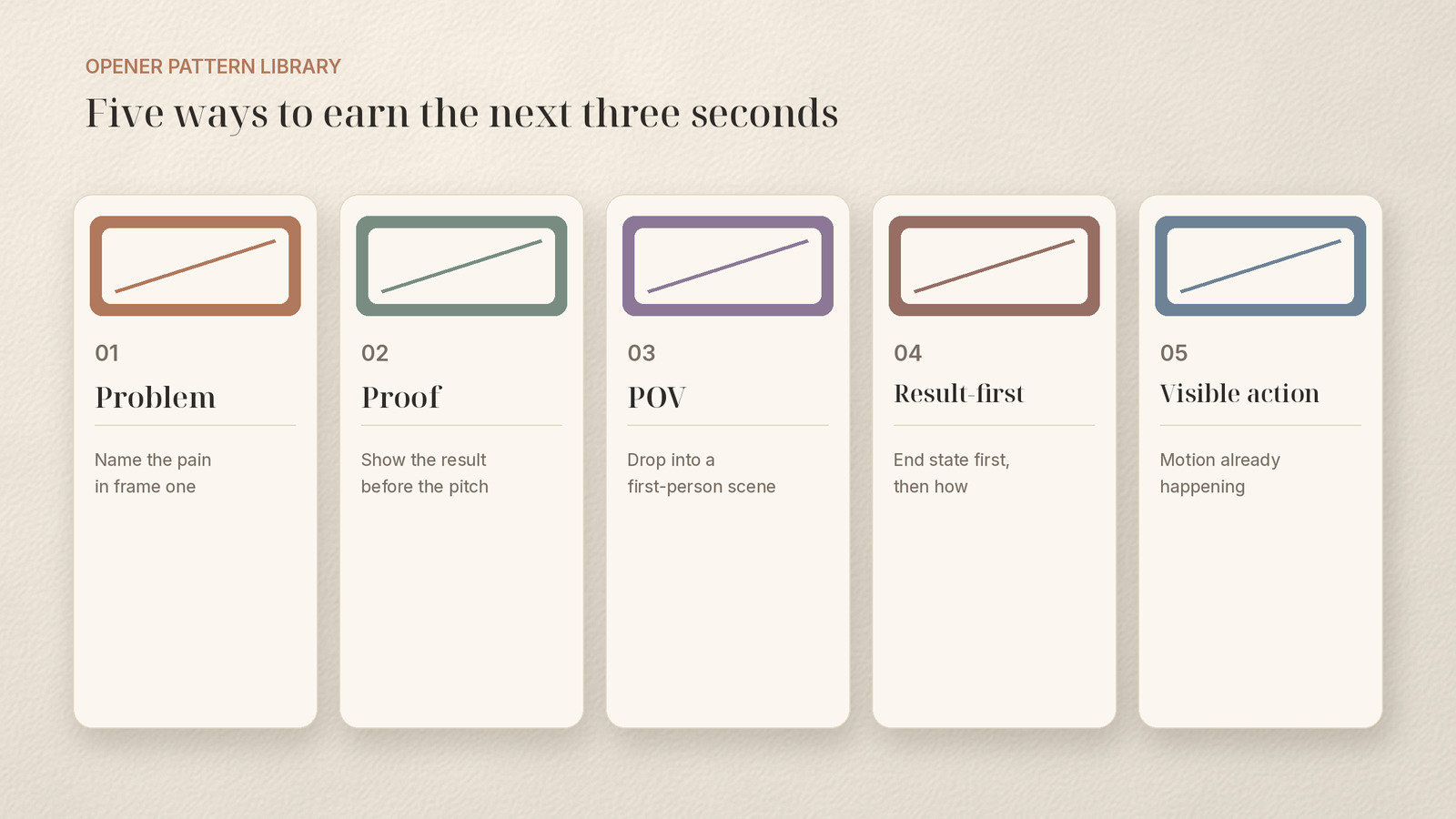
Use a Brand Opener Pattern Library. Pick one pattern per Reel. Write three candidate lines. Film the open so the pattern is visible in frame one. Build the body as the payoff to that promise.
| Pattern | First-second job | Brand-safe example |
|---|---|---|
| Problem | Name the pain the buyer already feels | "Your Reels die before second three" on a blank Insights chart |
| Proof | Show evidence before the claim | Hands unboxing a used product with wear marks visible |
| POV | Drop the viewer into a named role | First-person packing table: "If you run ads for local clinics…" |
| Result-first | Show the after, then rewind the how | Finished plated dish, then the 20-second prep |
| Visible action | Start mid-motion, never at rest | Pour, cut, peel label, swipe UI mid-flow |
Callout and contrarian opens work as optional extras when they still sound like your brand. Skip phrase dumps. Patterns travel across categories; stolen viral lines do not.
How should visual, text, and spoken work together?
Treat the open as three channels that should agree:
- Visual: mid-action or mid-result in frame one. No logo sting.
- On-screen text: a short muted-readable claim (a few words) that matches the pattern.
- Spoken: stakes or specificity that reward people who have sound on.
If the text says one thing and the picture shows another, the open feels like an ad. Keep them locked. Placement, safe zones, and mute QA live in the first-frame guide linked above. Do not rebuild that checklist here.
When you remake a trend only for a pre-validated open skeleton, run the remake trending Reels on-brand checks first. One borrowed skeleton is fine. A clone of someone else's joke is not.
Should you write the hook before you film?
Yes. Write three to five opener candidates before the body exists. Pick one. Then film the body as the answer to that promise.
Hunting for a hook in the edit usually means the open was a soft setup. Teams that write the open first waste fewer takes and cut dead air faster.
What do the first three seconds look like by vertical?
Beauty. Open on product mid-swatch or mid-fill, not a vanity pan. On-screen: "Shade check under daylight." Pattern: visible action or proof.
F&B. Open mid-stir, mid-pour, or mid-plate. On-screen: "Before service." Pattern: visible action or result-first.
D2C ecommerce. Open on unbox, wear test, or pick-to-wrap. On-screen: "What 30 days of use looks like." Pattern: proof or problem.
Services. Open on a real tool, inbox, or site problem. On-screen: "The booking leak we keep seeing." Pattern: problem or POV.
SaaS. Open on a confusing screen or a clear before/after UI. On-screen: "We made this harder than it needed to be." Pattern: problem or result-first.
Agencies. Open on a board or timeline with a killed concept. On-screen: "Why this idea failed brand fit." Pattern: POV or proof.
Keep type and tone consistent with Brand DNA from your website. Remix layouts from Instagram Reels templates for brands once the open pattern is chosen.
Which anti-patterns should you cut?
- Logo sting or brand bumper before any tension.
- "Hey guys / welcome back" as the first words.
- Product sitting still on a table while music starts.
- Burying the best line after second three.
- Vague "new product" announces with no stake.
- Audio-only jokes that fail when muted.
If a competitor could swap logos onto your first frame and lose nothing, rewrite the open.
Also watch for "soft brand" opens that feel safe and still fail: a slow pan across packaging, a founder waving before naming a stake, or a montage of lifestyle stills with no motion in frame one. Safe is not the same as stoppable.
How do you know a hook is working?
Use your own Insights. Watch retention or View Rate past the first few seconds. Compare two opens on the same body when you can. Keep what holds people into the payoff. Drop what spikes an early exit.
Do not chase invented industry retention percentages from tool blogs. Official Creators guidance points you to hook early and monitor View Rate. That is enough for a brand team.
Worked example: a D2C skincare brand
A four-person D2C skincare team sees Reels stall when they open on the bottle on marble. They pick two patterns for the month: proof and problem.
For proof, they film a 14-day cheek texture clip with the same light and angle. Frame one shows the day-14 skin, not the logo. On-screen: "Day 14, same light." Spoken line names the product only after the visual lands. Caption stays soft.
For problem, they open on a sink full of half-used serums. On-screen: "Too many steps, no routine." Body shows a three-step order. They write five opener lines first, film two, and keep the one that holds past the first beat in a quiet internal preview on mute.
They check Brand DNA for tone, schedule beside a packing BTS Reel (not instead of it), and fold winners into their weekly pick session. When the calendar is empty, they refill from Instagram Reels ideas for brands (blank calendar).
When is a trend open worth borrowing?
Borrow a trend skeleton only when the open pattern matches a buyer problem you already own. If the trend is a dance or a meme with no room for your product or service in the first three seconds, skip it.
Keep the beat structure. Replace the joke, the props, and the punchline with your assets. Run the remake checks linked above. A trend open is a pre-validated pattern, not a permission slip to look like every other brand on the audio.
Agencies managing several clients should assign one opener pattern per client week so feeds do not all open on the same contrarian line. Pattern variety across clients protects brand fit better than one "winning phrase" reused everywhere.
DIY open checklist
- Pick one pattern from the Brand Opener Pattern Library.
- Draft three opener lines that match that pattern.
- Film frame one mid-action or mid-result (no logo sting).
- Add short muted-readable text that matches the picture.
- Cut dead air before the promise lands.
- Preview the open muted on a phone.
- Compare to your own prior retention or View Rate after you post.
- Ship the mute/safe-zone checks with the first-frame checklist before publish.
Make on-brand Reels hooks faster with beREEL
The checklist works by hand. Teams lose time choosing opens that still match the buyer.
beREEL starts from your website. Paste it in and it builds Brand DNA (audience, offer type, personas, benefits, tone), then filters a TikTok-style feed of 600+ templates to those buyers. You remix a proven format onto your product or service, make photo and video Reels from assets you already have, and schedule to TikTok, Instagram, YouTube Shorts, Facebook, and Snapchat with performance learning for best hour.
Creating a free account takes about a minute, and you start with 170 free credits, no card needed: www.bereel.pro.
Open strong, then pay it off
Pick a pattern. Write the open first. Film mid-action. Link the first-frame ship gate for mute QA. That is how Instagram Reels hooks for brands earn the next three seconds without a fake retention chart or a stolen phrase list.