


In this article
Faceless Instagram Reels work for brands when the footage itself proves something a buyer cares about. Rank your options by trust. Hands using the product come first. Process and behind the scenes come second. Motion built from your own website photos comes third. Text over stock footage comes last, as a fallback. Add a voice only if it is real, and keep every on-screen line in your brand’s tone.
We call this the Product-Is-the-Face ladder. Each rung down is less effort, and it asks the buyer to take more on faith. This guide explains each rung, shows which one suits which kind of brand, and walks through three worked examples. It also covers the honesty rules that keep faceless Reels from feeling generic, using Instagram’s own guidance rather than folklore.
What is a faceless Reel for a brand?
A faceless Reel is a short video where nobody’s face carries the message. Hands, objects, places, screens and words do the work instead. For a brand, the point is not to stay anonymous. The point is to sell without needing a presenter. Maybe your founder hates being on camera. Maybe the team rotates. Maybe you simply want Reels you can make on a Tuesday afternoon without hair and makeup.
That makes brand faceless Reels a different job from the “faceless channels” you see in idea lists, which chase views in a niche. A brand has something those channels don’t: a real product, a real workspace and real photos. The ladder below is about using them in the right order.
The Product-Is-the-Face ladder: which footage should you use first?
Start at the top and only step down when you have to. Here is the short version, then each rung in detail.
| Rung | Footage | What it proves to a buyer | Effort | Best for | Watch out for |
|---|---|---|---|---|---|
| 1 | Hands using the product | It is real, it works, this is how it feels | Low to medium | Beauty, food and drink, makers, gadgets, fashion details | Messy backgrounds, nails or sleeves off-brand |
| 2 | Process and behind the scenes | A real team makes, packs or runs this | Medium | Makers, F&B, studios, SaaS (screen) | Showing private data or customer details |
| 3 | Motion from your own website photos | This is exactly what you will get | Low | Any brand with good product photography | Photos that look like ads, with no context |
| 4 | Text over stock footage | An idea or opinion, nothing about you | Lowest | Tips and myth-busting when nothing else fits | Instagram aims to show majority-text Reels less |
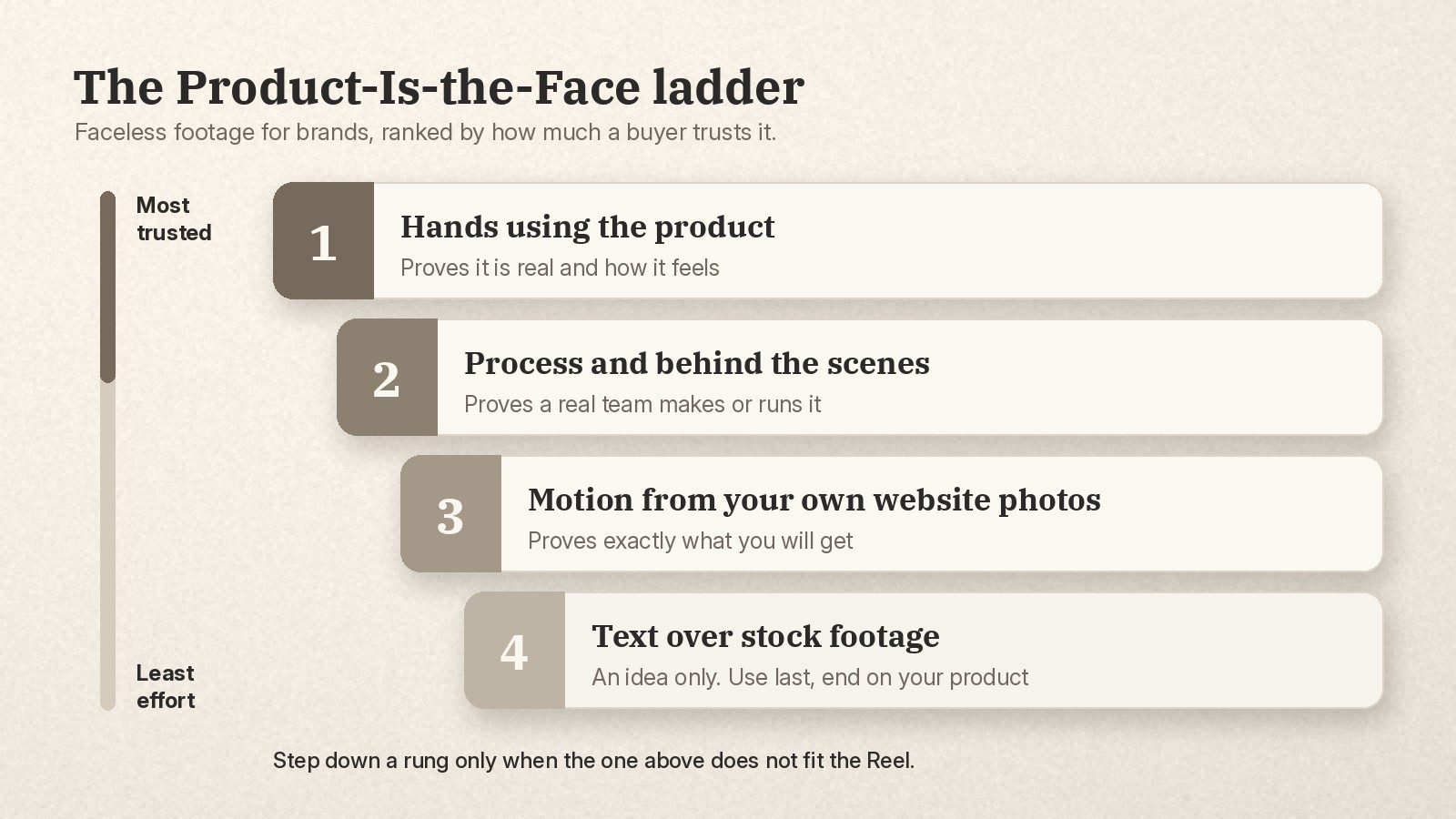
Rung 1: hands using the product
This is the most trusted faceless footage because it is hard to fake. A pair of hands opening a jar, pouring a coffee or snapping a case shut shows texture, size and how the thing behaves. It answers the buyer’s real question: what is it like to use?
Film it close, near a window, with the hands already moving in the first frame. Keep sleeves, nails and the surface in your brand’s palette, because in a faceless Reel those details become your brand. Three to five clips are enough: the closed product, the first touch, the moment it does its job, the result, and the product set down.
Rung 2: process and behind the scenes
One step down, the footage proves that a real operation stands behind the product. Think of a batch being mixed, an order being packed, a jacket being pressed, or a dashboard being set up on screen. Buyers rarely need to see the person. They need to see that someone careful is doing the work.
This rung is also the easiest to turn into a series, because your process repeats every week. Our guide to behind the scenes Reels has more formats that work without a face.
Rung 3: motion from your own website photos
Your website already holds your best product photography, shot and approved for exactly this purpose. Turning those stills into a vertical Reel with slow crops, sequences and short on-screen lines is the lowest-effort footage that is still entirely yours. It proves accuracy: this is the real product, in the real colours.
It sits below rungs 1 and 2 because stills can’t show texture or motion the way hands can. They also start to look like ads if you never add context. Pair a still with one line a buyer would say (“fits a 13-inch laptop”, “lasts one month of daily use”) and it earns its place. For the step-by-step, see how to turn product photos into on-brand Instagram Reels.
Rung 4: text over stock footage
This is the fallback for ideas, tips and opinions, when nothing in your own footage fits. It proves nothing about your product, so it should never be the backbone of a brand account.
There are also platform reasons to keep it rare. In his 2023 explainer on ranking, Instagram’s head Adam Mosseri wrote that Instagram aims to make certain Reels less visible, including “reels that are majority text, or reels that have already been posted on Instagram”, along with watermarked and low-resolution ones (Instagram). Instagram’s recommendation guidelines also list “unoriginal content that is largely repurposed from another source with only minor, immaterial edits” as content it may not recommend. If you use stock, keep the text short, add something of your own, and end on a real shot of your product.
Here is the line worth remembering: faceless is fine; footage that could belong to anyone is not.
How do you add a voice without a face?
Footage is one layer. Voice is the second, and it has its own levels:
- On-screen text only. Short lines, written the way your brand talks. This works for most rung 1 and rung 3 Reels, and for people watching with the sound off.
- A real voice from your team. Someone who actually works there, recorded in a quiet room on a phone. A voice adds warmth without anyone appearing on screen.
- Customers in their own words. Real reviews or voice notes, used with clear permission. Our guide to UGC Reels with clear rights covers how to ask.
What to avoid: a synthetic voice reading a “customer” review that no customer said. That is not faceless, it is fake, and buyers can usually hear the difference.
Three worked examples
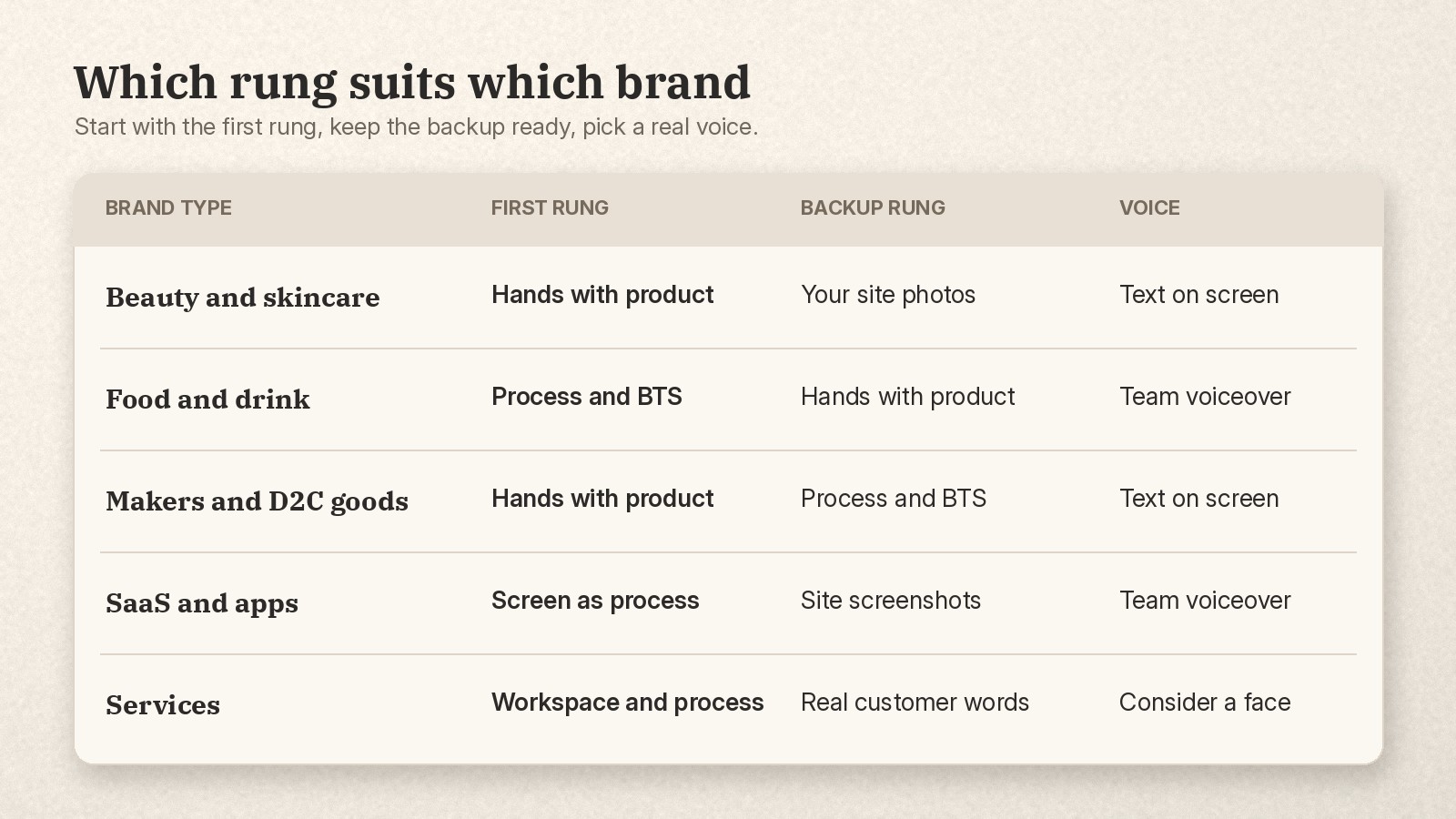
These are illustrative scenarios, not real customers. They show how the ladder bends to three different businesses.
A small skincare brand
The founder will not go on camera, and the brand sells three products online.
- Rung 1 (most weeks): hands pumping the cleanser, the texture on a fingertip, rinsing under a tap, the bottle placed back on a stone shelf. On screen: “Two pumps, no tightness after.”
- Rung 3 (launch week): the site’s product photos in sequence, each with one buyer line: “For combination skin”, “Fragrance-free”, “Lasts about two months.”
- Voice: text only, written in the brand’s calm, plain tone.
- One buyer per Reel: one Reel speaks to people with sensitive skin, another to people who travel. Never both at once.
A specialty coffee roaster
Two people roast and ship beans from a small unit.
- Rung 2 (the backbone): green beans poured into the roaster, the colour changing, beans cooling in the tray, bags sealed and labelled. On screen: “Roasted Tuesday, shipped Wednesday.”
- Rung 1: hands grinding and pouring a filter coffee with this week’s beans.
- Voice: the head roaster’s own voiceover on one Reel a week, explaining a single taste note.
- Rung 4 (rarely): a short myth-busting tip (“Don’t store beans in the fridge”) over a stock shot of a kitchen, ending on their own bag.
A B2B invoicing tool
There is no physical product, and nobody on the team wants to be the face.
- Rung 2 (screen as process): a screen recording of an invoice built in under a minute, cursor slowed, with the client’s details blurred. On screen: “Invoice sent before the coffee cooled.”
- Rung 3: clean product screenshots from the website, cropped to one feature each.
- Voice: a product manager’s voiceover explaining one setting, recorded on a phone.
- Guardrail: never show real customer names or amounts. Use a demo account.
If your business is a service where the person is the product, like a coach or a consultant, a face may still be the better choice. Our guide to Instagram Reels for service businesses covers when faceless fits and when it doesn’t.
Brand honesty rules for faceless Reels
Faceless Reels lose trust fastest when they start to feel like they could belong to any account. These rules keep them yours:
- No fake people. Don’t use AI-generated people or voices to stand in for real customers or staff. Instagram’s recommendation guidelines say it tries not to recommend accounts that repeatedly share content “that prominently features a photorealistic AI-generated person” unless the account carries the AI-generated profile label (Instagram).
- One buyer per Reel. Decide who the Reel is for before you film. A Reel aimed at everyone usually says nothing to anyone.
- Your tone on screen. The words carry the personality a face would carry, so write them the way your brand talks.
- Original footage, no other app’s watermark. Export clean files, and don’t repost someone else’s Reel with a caption swap.
- Five hashtags at most. Instagram’s help page says you can use up to 5 tags on a post (Meta Help Center). Put the real description in your caption and on-screen text.
How do you know if a faceless opening is working?
Watch what happens in the first second on a phone with the sound off. If it is not clear what is in the frame, people will scroll before your product gets a chance.
Then look at the numbers Instagram gives you. Meta describes its Edits app as offering “real-time feedback on factors that can affect distribution (like skip rate)” (Meta). Use that feedback to compare your own Reels against each other, rung by rung. It is not a target to hit.
Your faceless Reels checklist
Run this by hand this week. You don’t need any special tool.
- List everything you can film without a face: hands, process, packing, screens, places.
- Pull the ten best product photos from your website.
- Decide one buyer for each Reel before filming.
- Write every on-screen line first, in your brand’s tone.
- Film your rung 1 and rung 2 clips in one session, under the same window light.
- Use stock only for idea Reels, and end each one on your own product.
- After a few days, compare skip feedback across rungs and make more of what holds attention.
Where beREEL fits
The slowest part of faceless Reels is not filming hands. It is deciding which format suits which buyer, and turning a folder of stills and clips into Reels that look like your brand every time. beREEL starts from your website. It pulls your Brand DNA from your website: audience, offer, buyer personas, benefits and tone. It then filters an inspiration feed of 600+ Reel templates to the ones that fit those buyers. You remix them onto your own photos and clips, then adjust pace, crop and cuts in the editor. No one has to step in front of the camera.
Your product can carry the Reel. Start free on beREEL, no card needed, and make your first faceless Reel from the photos already on your site.